A number gets repeated across roofing sites so often it reads like settled law: once 25 percent of a roof is damaged or repaired, the whole roof has to be replaced. That idea is real, but it lives in a handful of state building codes, and it is not automatically an insurance rule. What actually decides whether your roof gets patched or torn off comes down to two separate things: your state's adopted building code, and, if insurance is involved, the wording of your policy.
Where the 25 percent idea comes from
The 25 percent figure is a reroofing cap that some state building codes use to stop a roof from being patched indefinitely instead of properly replaced. The base International Residential Code, the model code most of the country builds from, takes a narrower approach. Its reroofing chapter allows a new roof covering to go over an existing one only under specific conditions: when the manufacturer's own instructions allow it, when the new roof is a structurally independent system such as a standing seam metal roof that carries its own load, when metal panels or tile go over old wood shake under set conditions, or when a coating is applied over an existing membrane without tear-off, according to the International Code Council. None of those conditions are stated as a percentage of roof area.
What Minnesota's code actually requires
Minnesota does not add a 25 percent trigger of its own. The state adopts the International Residential Code as Minnesota Rules Chapter 1309, and that code is mandatory statewide with only limited local exceptions, according to the Minnesota Department of Labor and Industry. That means the recover conditions above, not a homegrown area threshold, govern when a Minnesota roof can be recovered versus when it needs a full tear-off. A roofer or building inspector checks those specific conditions, not a running tally of damaged square footage.
What Wisconsin's code actually requires
Wisconsin's own reroofing rule works on a different measure entirely: layers and deck condition, not area. Under the state's Uniform Dwelling Code, a new roof covering cannot go over an existing one where the existing roof is water soaked or too deteriorated to serve as a base, and it cannot go over a roof that already carries two or more layers of permanent roof covering, according to the Wisconsin Legislature.
Why the same number shows up in insurance conversations
A version of the 25 percent figure also gets used informally in claims conversations, when an adjuster or a contractor is weighing whether storm damage justifies replacing a full roof slope instead of patching it. That is a practice some people apply, not a rule written into Minnesota or Wisconsin insurance law. What actually decides an insurance payout is the policy's own wording: what counts as covered damage, whether the roof is insured at replacement cost or actual cash value, and how the policy handles a slope that can no longer be matched. Coverage has also been getting narrower. The Minnesota Department of Commerce has warned homeowners that some insurers now limit wind and hail coverage to shingles or siding that is actually punctured or torn, not cosmetic damage, alongside separate, higher deductibles just for wind and hail claims. Whether metal or shingle, how an insurer treats a given roof already varies by insurer and by state, and the same is true here.
Policies, lenders, and local rules differ, so check your own policy or ask your agent before you rely on any of this.
When a repair is enough and when it is not
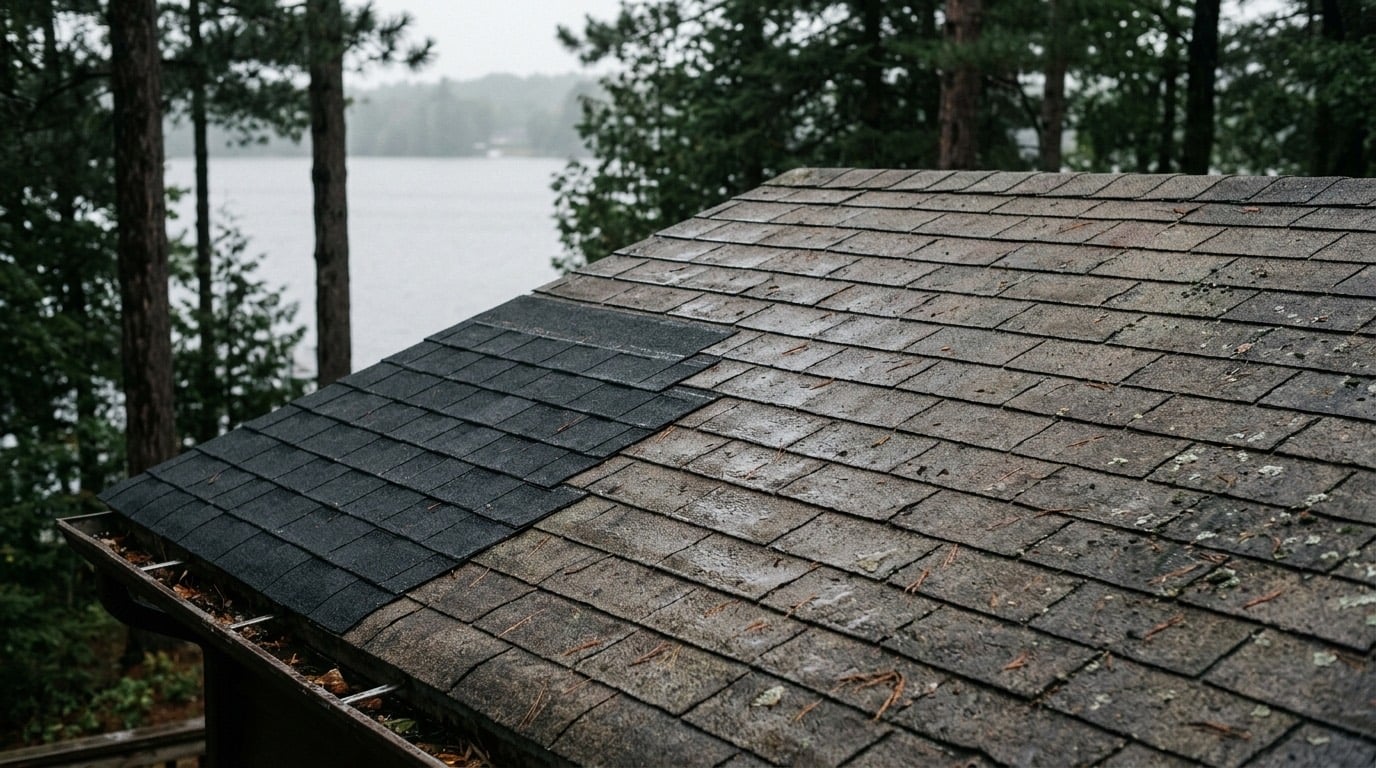
A roof does not need to hit any specific percentage to justify a full replacement. Age matters on its own: a roof nearing the end of what its shingles are actually rated for is a poor candidate for another patch even if the damaged area is small, because the surrounding material is already brittle. Spread also matters more than a single number. Damage scattered across every slope, rather than concentrated in one section, usually points toward full replacement even when the total area is modest, because there is no clean line to tear off to.
Warning signs and when to call a professional
- Granules collecting in gutters or downspouts, a sign shingles are wearing past their protective layer
- Shingles that are cupping, curling, or cracking across more than one slope
- Soft or spongy spots felt from inside the attic, checked from the attic floor, not by walking the roof
- Daylight visible through the roof deck when you look up from the attic
- Water stains on ceilings or attic framing that show up after storms, not just during them
- A roofer or permit history that shows the roof already carries more than one layer of covering
Anything beyond a ground-level or attic check is a professional's job. Climbing onto a damaged roof to inspect it yourself adds real risk for no information a trained inspector cannot get more safely.
The bottom line
The 25 percent rule is a real concept in some states' building codes, but it is not Minnesota's rule, it is not Wisconsin's rule, and it is not an insurance law in either state. Minnesota follows the base International Residential Code's recover conditions, Wisconsin caps roofs at two layers and blocks recovering over a bad deck, and insurance payouts turn on policy wording rather than a fixed percentage. Ask a local roofer or your building department which code condition applies to your roof, and ask your insurance agent what your specific policy actually covers.
People also ask
What is the 25% rule for roofing?
It is a reroofing threshold some state building codes use: once damage or repair reaches about a quarter of the roof, the whole roof has to meet current code instead of being patched. Minnesota and Wisconsin do not write that specific threshold into their own adopted codes.
What is the 25% rule in roofing?
Same idea under a slightly different phrasing: a cap, in some states' codes, on how much of a roof can be repaired or recovered before the entire roof must be replaced to current code. It is a building code concept, not an insurance guarantee, and Minnesota and Wisconsin use their own rules instead.
What is the difference between a roof recover and a roof replacement?
A recover installs a new layer over the existing roof and is only allowed under specific conditions, such as following the manufacturer's instructions or installing a structurally independent system like standing seam metal. A replacement strips the roof to the deck first. Recover has real limits on layers and deck condition.
Does homeowners insurance always pay for a full roof if part of it is damaged?
No. Whether an insurer pays for the whole roof or just the damaged section depends on the policy's own wording, the type of damage, and state rules on things like matching. Some policies now narrow storm coverage further. Ask your agent what your specific policy says before assuming either answer.
Sources
- 2021 International Residential Code (IRC) - R908.3.1 Roof recover, International Code Council
- Makeup of the Minnesota State Building Code, Minnesota Department of Labor and Industry
- Wisconsin Administrative Code, SPS 321.28, Weather protection for roofs, Wisconsin Legislature
- Consumer alert: MN Commerce advises Minnesota homeowners to check insurance coverage for wind, hail limits, Minnesota Department of Commerce