A "30 year," "50 year," or "limited lifetime" label on a shingle describes the manufacturer's warranty, not a forecast of how long the roof will hold up on your house. Warranty terms and real-world service life are two different things, set by two different sets of rules, and mixing them up is a common misunderstanding.
What a shingle warranty actually promises
A shingle warranty covers defects in the material itself: cracking, curling, or granule loss that traces back to how the shingle was manufactured, not to weather, age, or how it was installed. Coverage is also not flat for the life of the warranty. Limited lifetime plans typically pay full replacement cost only for an initial period, then shift to prorated coverage that pays a shrinking share of the material cost as the roof gets older. The National Roofing Contractors Association notes that a manufacturer's warranty does not replace the need for regular inspection and maintenance.
Installation problems are also the most common way a warranty gets voided before it is ever tested by weather.
What actually decides how long a roof lasts
Four things matter more than the number on the wrapper: ventilation, installation quality, climate, and how much direct sun and hail exposure the roof gets. Heat trapped in a poorly ventilated attic bakes the underside of the shingles from below, adding to the aging that sun already causes from above.
Impact resistance is a separate, testable property. Shingles are rated under UL 2218, a standardized test that drops steel balls to simulate hailstone impacts, producing four classes. A Class 3 product is tested against a 1.75 inch steel ball and a Class 4 product against a 2.00 inch ball, each dropped from a height calibrated to match a real hailstone's impact energy. Class 4 is the more demanding, more impact-resistant rating. It is worth knowing that the test measures cracking on the back of the shingle only: granule loss or dents visible from the top do not count as a failure under UL 2218, so a shingle can pass the test and still look worn after a hailstorm.
Why Minnesota and Wisconsin winters shorten real-world lifespan
Freeze and thaw cycling, ice, lake wind, and a short building season all work against a roof faster here than in a milder climate. In Duluth, the average window between the last spring freeze and the first fall freeze is only about 138 days, which leaves most of the year open to freezing nights, and repeated freezing and thawing is hard on any roof. Hail is not rare, either: the National Weather Service has recorded hail up to 4 inches in diameter in the region, along with repeated baseball-size hail events. None of that shows up in the warranty term printed on the wrapper.
At what age is a roof considered old?
There is no single official cutoff, but 20 years is a common checkpoint. Insurers commonly require an inspection once a roof passes 20 years old, and some will not write a new policy on an older roof at all. That threshold is about risk underwriting, not a verdict on when a roof fails, so a well-maintained roof can still be sound well past 20 years while a neglected one can fail earlier.
Should a 20 year old roof replace?
Not automatically. Start with an inspection and look for warning signs before deciding between a repair and a full replacement.
- Shingles that are curling, cupping, or cracked
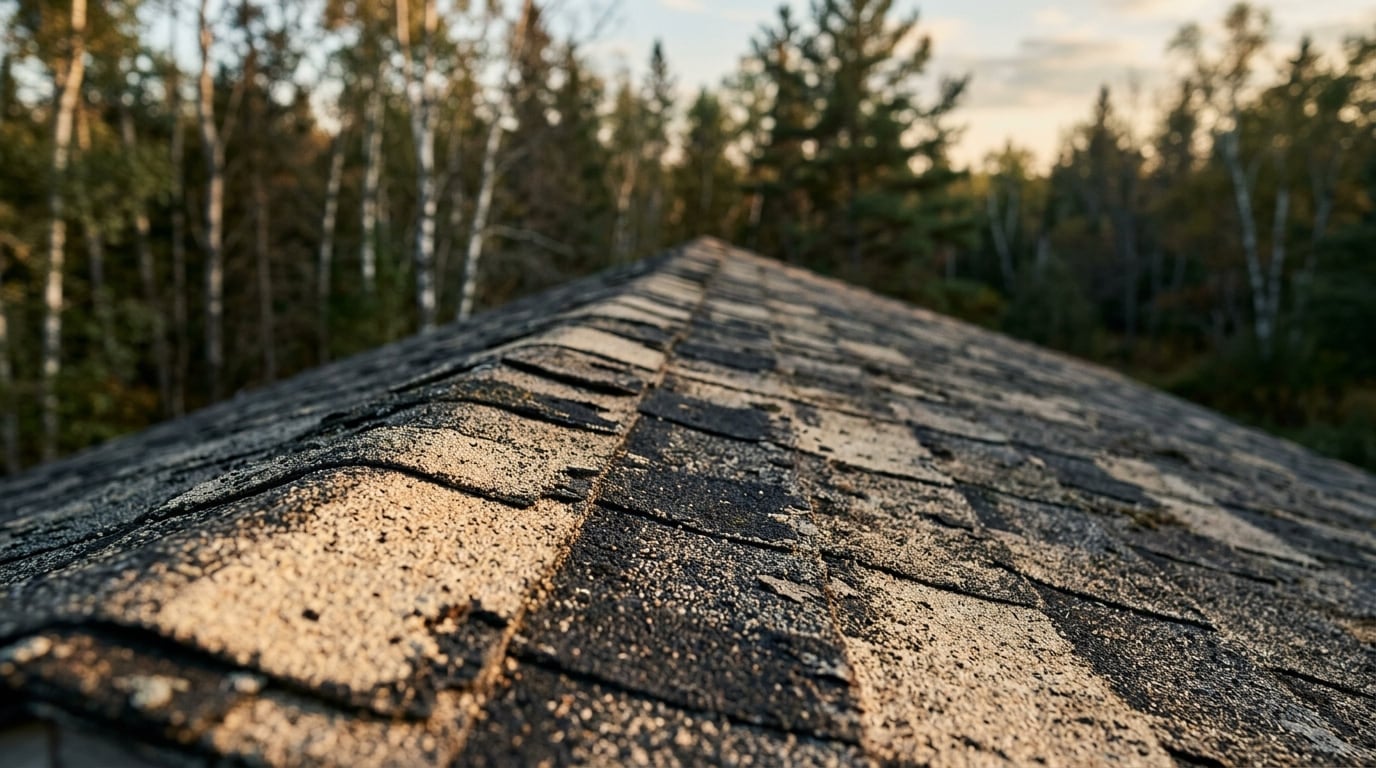
- Bald patches where the mineral granules have worn away
- Shingles missing entirely, or exposed nail heads
- Daylight visible through the roof deck from inside the attic
- Soft or spongy spots when walked on (a job for a professional, never the homeowner)
- Sagging anywhere in the roofline itself
A handful of isolated warning signs is often a repair. Several at once, or any sign of active leaking, is usually a signal that replacement will be more cost-effective than repeated repairs. Never inspect a roof by climbing onto it: bring in a licensed roofing professional to assess the deck, flashing, and ventilation before any work is scoped.
The bottom line
The number on a shingle wrapper describes a warranty, not a lifespan. What actually determines how long a roof lasts is ventilation, installation quality, and how much sun, hail, and freeze-thaw cycling it absorbs, all of which vary more in Minnesota and Wisconsin than the warranty paperwork accounts for. Twenty years is a reasonable point to schedule an inspection, not a verdict on a roof's condition. When warning signs stack up, or a roof is aging in a demanding climate, the next step is a professional assessment, not a guess based on the number printed on the original wrapper.
People also ask
Is a 20 year old roof bad?
Not by itself. Twenty years is roughly when insurers start requiring a roof inspection before writing or renewing a policy, which makes it a reasonable checkpoint rather than an automatic problem. Condition matters more than age: a well-ventilated, well-installed roof in a mild climate can still be sound at 20 years, while a poorly ventilated one may already be failing.
Can a roof last 40 years?
Yes, but it takes more than the material. Roofs that approach 40 years typically combine a durable product, balanced attic ventilation, correct installation, and a climate that is not especially hard on shingles. The warranty term printed on the wrapper does not predict this: it describes defect coverage, not an expected lifespan.
Will insurance cover a 20 year old roof?
It depends on the insurer and the policy, so check your own declarations page or ask your agent. Many companies require an inspection once a roof passes 20 years and some decline new policies on older roofs or pay only actual cash value (depreciated) rather than full replacement cost. Rules vary by company and by state.
Sources
- How Your Roof Influences Your Home and Business Insurance, Insurance Information Institute
- UL Solutions, IBHS Drive Trust in Residential Roofing Shingles, UL Solutions
- Relative Impact Resistance of Asphalt Shingles: Summary of UL 2218 Impact Tests, Insurance Institute for Business and Home Safety (IBHS)
- Guidance for Homeowners, National Roofing Contractors Association (NRCA)
- Significant Weather Events Database, National Weather Service (NOAA), Duluth office
- Frost/Freeze Climatology, National Weather Service (NOAA), Duluth office